Zur deutschen Version geht es hier.
Admittedly, the title is a little too obvious in relation to the current album by the Austrians of HARAKIRI FOR THE SKY, but for me it just fits too well! Their latest album is a testament to catharsis and the losses we suffer in life. In the interview, vocalist J.J. and guitarist M.S. also talk about how Scorched Earth differs from its predecessors and how it feels to have so many things happening for the band right now.
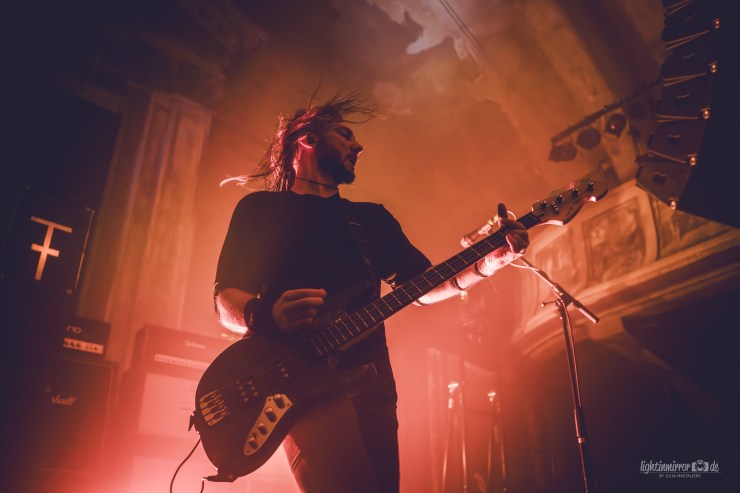
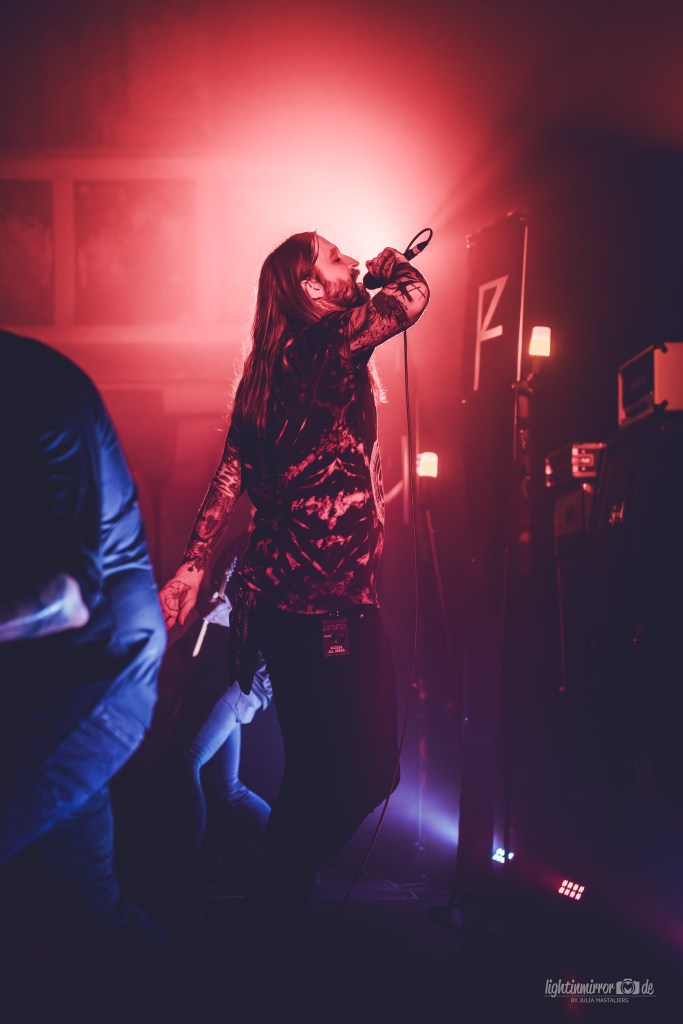
Thanks at this point, as always, to lightinmirror.de for the wonderful pictures! Thanks also to Patrick for connecting us and to Chris, who managed the on-site wonderfully!

Shieldmaiden’s Voice: If you had to describe HARAKIRI FOR THE SKY in three words, what would they be?
M.S.: Good question… I would say for me it’s self-realization, catharsis and cohesion!
J.J.: Mhm… I would also have said catharsis! Maybe freedom too, but that sounds so pathetic… But freedom just fits, because the band has made a lot of things possible for us that we probably wouldn’t have experienced in this way or has taken us to places that we wouldn’t have seen in this fashion.
SV: But freedom is a good keyword: What are the biggest personal benefits you get from music?
M.S.: There is a lot to get rid of and there are many ways to do it. Other people go to the gym and hit a punching bag, but for us, music is a way of creatively coping and getting things off our chest. In that sense, the keyword freedom really isn’t bad! It’s very liberating, combined with the fact that we’re both music lovers. If you have the opportunity to do it yourself and get the music out to people, and to a degree that you can survive on it, then that’s a very nice thing.
SV: Where would you particularly see this self-realization on your album Scorched Earth?
M.S.: It’s a snapshot of the current times, where a lot is really going to hell, as they would say in Austria, and a reappraisal of that. There are current topics, as well as topics that still concern us from the past. It’s a depiction of how we currently see the world and it doesn’t look rosy.
SV: But to what extent does Scorched Earth differ from its predecessors?
J.J.: I interpret the title Scorched Earth in two different ways: One way is what M.S. has already described, namely the world we live in and what we are moving towards. On the other hand, “Scorched Earth” is a metaphor for broken relationships or for something you’ve lost but put your heart and soul into. As most HARAKIRI FOR THE SKY fans will know, I’m always about these themes. Lost love and alienation are always present as themes and in a way it’s always recent. But it’s also something very true to life. That’s exactly why I have to write about it, I can’t write about some fantasy stories or about something that doesn’t affect me at all. I write about the things that I have experienced myself and about the things that touch me and try to package everything as poetically as possible.
SV: I find it interesting how you describe it, because for me the other HARAKIRI FOR THE SKY albums were always a soundtrack to the night. But when I listen to Scorched Earth, it’s still night, but I can see a silver lining in the sky, I can see that the sun is already rising a bit. Would you say that it now has a more positive connotation? It’s still melancholy, but no longer so deeply sad.
J.J.: I know what you mean. These allusions to suicide have become less frequent and this longing for death in general doesn’t come up so often anymore. It may be that it’s a little less intense. But I find the sadness in general and the finality of these farewells that are sung about in the lyrics almost sadder than the others. I don’t think it’s improved or worsened, it’s just a different kind of sadness, perhaps mixed with anger.
SV: Maybe the other albums dealt more with the anger about “why is it like this?”, whereas Scorched Earth deals more with the anger that it is like this, that it is so irrevocable and so final.
J.J.: Yes, that’s exactly how I see it!

SV: Regardless of the fact that you’re dealing with incredibly heavy topics that many people can relate to, a lot is happening for you with this album. You were in the USA two weeks ago with SWALLOW THE SUN and now we’re sitting here in Leipzig, it’s all going from strength to strength for you. How does it feel for you to be so busy with this album?
M.S.: On the one hand, it’s very nice because we can do what we love. On the other hand, it’s important to have time to relax at home. It’s also one of the more pleasant aspects that if you’ve been away for a long time, you have more time afterwards. That wouldn’t be possible in a 9 to 5 job, where you have several days in a row to yourself and to be at home or go on vacation with your partner. The working hours that others have from Monday to Friday are now concentrated for us and we have more free time in between. I actually quite like it that way! Especially as it’s not like we have to do something we don’t like!
J.J.: On tour, you always have better days and worse days. Then you can’t sleep for two nights, you’re depressed and then a concert comes along that is super good and you get a surge of euphoria and everything is good again. It’s a constant up and down, but what comes out in the end is a cool memory and you’ve created something cool.
M.S.: I can only speak for myself now, but even if the days start out shitty, you don’t feel like it and then you go on stage and by then you know again why you’re doing it and that it’s worth it. There hasn’t been a concert so far where I’ve walked off stage afterwards and thought that I didn’t enjoy it. I think that as long as it stays like this, you can keep doing it. We’ve chosen the right thing!
SV: You’re welcome to carry on as far as I’m concerned! The current tour is a very big one. I remember seeing you once when there were only 50 people there and today you sold out the UT Connewitz. What are your hopes for the tour?
M.S.: It would be nice if people liked and appreciated the music and we also like to play in front of only 50 people who feel the music. You shouldn’t punish those who come anyway, because they can’t help the people who didn’t come. There are a lot of small shows that are a lot of fun, but it’s nice that the work and continuous playing pays off and that there still seem to be people who didn’t know our music before, but who find it appealing. That makes us very happy, of course.
SV: When you look into the future, what are your hopes for you and the band?
M.S.: That’s a tough question! I’m just going to see what we can do now and I don’t know what it will look like with a new album at some point.
J.J.: It’s very hard to make any future plans, it’s hard to plan anything. It probably won’t be the case that we don’t want to do the band anymore, but a new album in two years or in four years or what exactly that will look like, we just don’t want to think about that yet.
M.S.: It’s always a chapter from album to album, at the end of which there’s always a bit of peace and quiet and then we’ll do something new at some point. We always look at what impressions we have gathered in between.
J.J.: We don’t plan anything, we don’t say something like “We want to be more experimental on the album!”. No! What is, that is! What it becomes, that’s what it becomes. We just want to make music that we want to play and that we stand behind. It just has to be authentic.
SV: Unfortunately, that brings us to my last question, which is perhaps a little philosophical! If your younger selves could see you now, what would they say?
M.S.: Can you ask the question again in three hours? [we laugh]
J.J.: The whole of life is a learning process and on the one hand, I wish I had done many things differently or not at all in my private life. On the other hand, it’s also the case that these decisions have brought me exactly to the point where I am today. It’s all made me the person I am today and I think that’s quite alright. So I can live with it, so to speak. Every misstep somehow brings you forward anyway.
M.S.: Like in a rocking chair! If you swing backwards, you swing forwards again. I think my former self always wanted to make music and express himself creatively.
J.J.: We’ve never really let ourselves be swayed, we’ve always done our thing. In the end, it just developed into what it is now. You have a certain vision for yourself and even then, not all decisions are right. For example, you can think 10 years later that maybe you should have produced one or two albums differently. Ultimately, if you have a vision and want to realize it, then you should just do it!
M.S.: We have a certain overlap when it comes to music, but we also listen to very different things. The whole mixture of what we do, me doing the music and him doing the lyrics, people find it interesting because it seems to have enough originality. That’s a very nice thing!
I’m not exaggerating when I say that I’m always grateful for interviews like this. It’s one thing to love a band, but it’s quite another when you can ask them your own questions in such contexts. HARAKIRI FOR THE SKY have had a firm place in my heart for years (and with the special editions of their albums also a place on my shelf) and that’s why it’s just a great feeling when I can post something like this. But that’s it for the sentimentality at this point! I’ll continue here in May with two other things. So stay tuned!

 Shieldmaiden's Voice